Part of our complete catalog of cleanup services.
Visual mold inspection in Austin begins with trained inspectors and precise instruments, not petri dishes. We're a TDLR-licensed Mold Remediation Contractor (MRC), and our focus is on identifying where moisture and visible growth exist in your home or building so you're fully informed before any work starts.
What Mold Looks Like in Central Texas
Austin's climate can be tough on buildings. Humidity from Lady Bird Lake, summer storms, and the tight crawl spaces typical in Hill Country pier-and-beam construction create conditions where moisture accumulates in unexpected places. A musty smell in a room with no visible discoloration might still mean active growth behind drywall or under flooring.
In the Austin metro, including Travis, Williamson, Hays, and Bastrop counties, we often encounter condensation on HVAC supply lines, water seeping around window frames, and standing moisture under floors after a flooding event. Knowing precisely where to inspect is crucial.
What Our Visual Inspection Covers
Our evaluation is a detailed walkthrough of your property. We're not rushing through the house with a clipboard. We use instruments and structured methods to provide a clear picture of current conditions.
What we look for and how:
- Visible growth: We examine every surface where mold commonly appears: walls, ceilings, subfloors, framing, insulation batts, and the backside of drywall at penetration points.
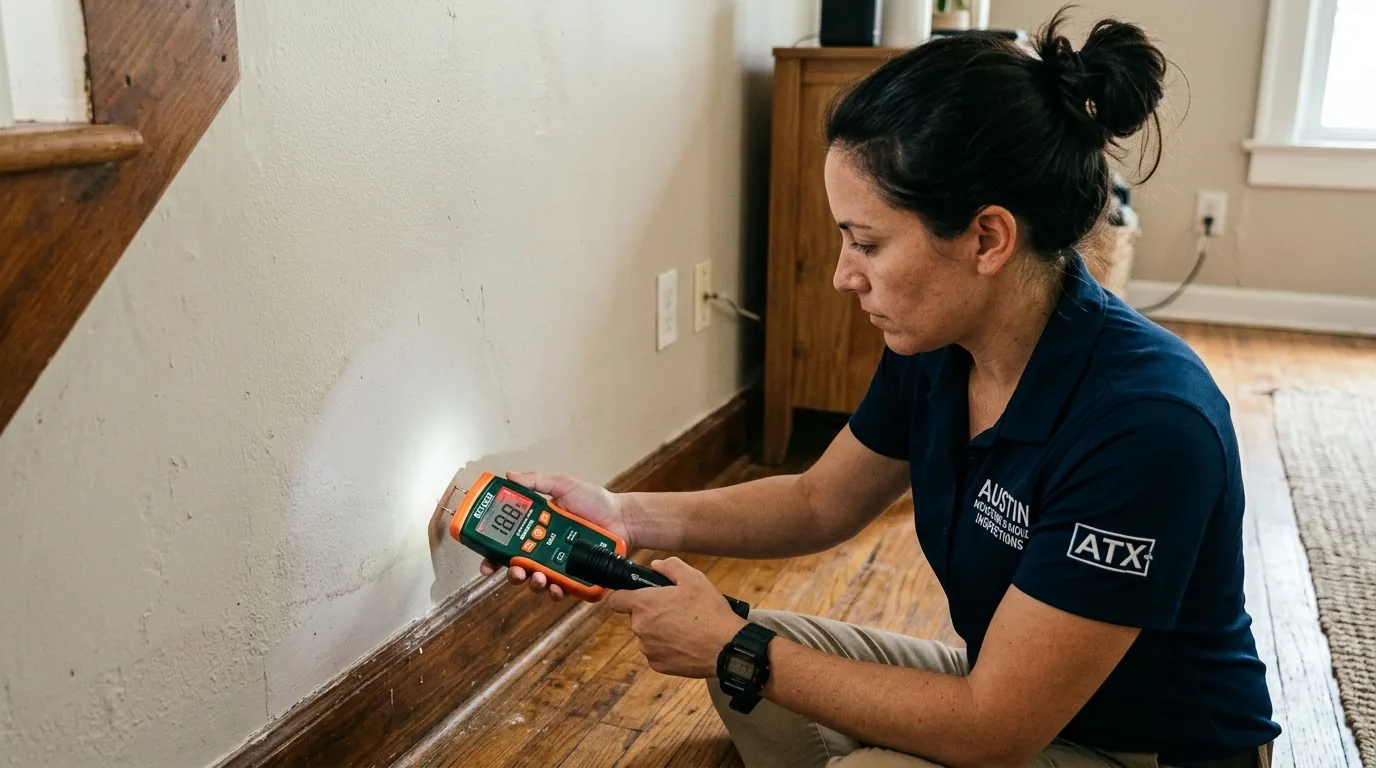
- Moisture meter readings: We use non-invasive meters against walls, floor sheathing, and ceiling materials to detect elevated moisture without cutting into surfaces.
- Thermal imaging: A calibrated infrared camera uncovers temperature differences that indicate hidden moisture pockets. Cool spots behind walls often reveal leaks or trapped condensation invisible otherwise.
- HVAC and ductwork check: We inspect air handler units, coil pans, and ducts for condensation buildup and visible microbial growth.
- Crawl space and attic access: Confined spaces get a detailed walkthrough. See what we find under the roof deck and encapsulation and vapor barrier work below the floor for specifics on these areas.
After the walkthrough, we provide a written summary of the conditions found, locations of elevated moisture readings, and our recommendations for next steps.
Common Findings in Austin-Area Homes
Central Texas homes often encounter certain issues. Here's what we typically find during a visual evaluation.
Attics. Inadequate ridge and soffit ventilation traps humid air, leading to black staining across OSB sheathing, especially in older homes near the 183 corridor or in the Barton Hills neighborhood.
Crawl spaces. In South Austin and the Hill Country, pier-and-beam homes have exposed soil under the floor. Without a proper vapor barrier, ground moisture seeps into the framing. A moisture meter reading over 19% in floor joists is a key indicator.
Bathrooms and laundry rooms. Exhaust fans venting into the attic instead of outside are common oversights. The moisture feeds visible growth on framing within a few months.
HVAC systems. An air conditioner in Austin's summers extracts significant moisture from the air. When a drain pan clogs or a coil is undersized, water backs up against the ductwork and framing.
After flooding. Properties along the San Gabriel River, Lake Travis, and low-lying areas of Buda and Kyle that flooded in past years might still show moisture damage. A moisture assessment can reveal where historic damage caused elevated readings.
When a Licensed MAC Is Required
We’re upfront because Texas law mandates it.
We conduct visual inspections and moisture assessments. We don’t perform air sampling, surface collection, or lab analysis. Under Texas Occupations Code Chapter 1958, an MRC is not permitted to perform mold assessment work on the same project. That role belongs to a separately licensed Mold Assessment Consultant (MAC).
A MAC is necessary in these situations:
- You need a written mold remediation protocol before a cleanup on a large project.
- You want a post-remediation clearance evaluation to verify standards were met.
- Your insurance carrier or a buyer's inspector requires a written assessment with findings.
We partner with independent licensed Mold Assessment Consultants when a written protocol or post-remediation verification is needed, ensuring you’re connected with a qualified MAC as required. We never attempt both sides ourselves, and no reputable contractor should.
What Happens After the Evaluation
After receiving our written findings, the next steps depend on what we discover.
If our moisture readings and visual review confirm active growth, we can proceed with remediation planning. You’ll have clear documentation to provide to your insurance carrier. Texas homeowners insurance often covers mold only if it results from a covered peril like a burst pipe, so documentation is crucial.
If a MAC-produced protocol is necessary first, we’ll coordinate that handoff. Once the MAC provides the protocol, we execute the structured cleanup approach and handle the demo and cleaning side of the job per that protocol.
You won’t be left guessing about the next move.
Why Austin Homeowners Call Us First
We hold an active TDLR Mold Remediation Contractor license, and our technicians carry IICRC AMRT (Applied Microbial Remediation Technician) certification. We adhere to IICRC S520 Standard for Professional Mold Remediation on every project.
We work on your timeline, maintaining a 24-hour response window because a moisture problem that waits for 72 hours becomes bigger.
We are familiar with this region. Central Texas construction quirks, Hill Country moisture patterns, and specific failure points across Austin's housing stock are familiar to us, sharpening our findings.
Our license number is . Ask to see it. Every contractor you speak with should provide theirs without hesitation.
Frequently Asked Questions
What does a visual mold inspection include?
We conduct a complete walkthrough of your property, using visual review, non-invasive moisture meters, and a thermal imaging camera. We examine walls, ceilings, floors, attic space, crawl spaces, and HVAC components for visible growth and high moisture. After the visit, you receive a written summary of conditions and our recommendations.
Do you do mold testing?
No. We don’t perform lab mold sampling, air collection, or surface analysis. Texas licensing rules under TDLR separate mold assessment work from mold remediation work. An MRC is not permitted to do both on the same project. When a written protocol or post-remediation clearance is needed, we work with independent licensed Mold Assessment Consultants.
How much does a mold inspection cost in Austin?
Our visual evaluation fee depends on property size and scope, often applied toward any following remediation work. For context, full mold remediation projects in Austin range from roughly $1,433 to over $6,000, averaging about $3,509 according to Angi's Austin mold remediation cost data. Call (512) 900-5395 for an estimate.
Will my homeowner's insurance cover a mold inspection?
It depends on the moisture cause. Texas homeowners insurance generally covers mold remediation only when the damage results from a covered peril, such as a pipe burst or storm-related water intrusion. Slow leaks are often excluded. Our written inspection summary gives you the documentation needed for a claim.
How long does the inspection take?
Most residential walkthroughs last one to two hours. Larger properties or buildings with multiple suspected areas might take longer. We prioritize accurate readings over time constraints.
When is a Mold Assessment Consultant required instead of just a visual inspection?
A MAC is necessary when a formal written remediation protocol is needed before cleanup, a post-remediation clearance evaluation is required, or your situation involves a legal proceeding. We’ll tell you during or after our walkthrough if a MAC is needed and connect you with a qualified professional.
Are you licensed to perform mold work in Texas?
Yes. We hold an active TDLR Mold Remediation Contractor (MRC) license, number , and our technicians have IICRC AMRT certification. Texas requires separate licensing for mold remediation contractors and mold assessment consultants, and we refer assessment and protocol work to independent MACs.
Ready to schedule a visual evaluation? get in touch right now or call (512) 900-5395 and we'll confirm availability within 24 hours.